

Circulate and Stay Sharp
Section titled “Circulate and Stay Sharp”Welcome to the fourth in a series of articles about the brain and how to keep it healthy as we age. In our first three articles we explained that the very structure of the brain, with it's magical and intricate loom of tiny nerve tendrils, creates its huge appetite for energy production. We outlined the damaging consequences of producing that energy, and the nutrients that have been shown to mitigate that damage. This month we will discuss how the brain gets its fuel and what can happen when it doesn't.
The Brain is a Fuel Hog
Section titled “The Brain is a Fuel Hog”In order for you to think, understand, and remember, the tiny mitochondria in your brain must consume fats and carbohydrates and burn oxygen to turn this fuel into energy.
Since the brain burns a great deal of fuel, it requires a great deal of blood to get that fuel. Let's look at the pipes that bring fuel and oxygen into our cranium.
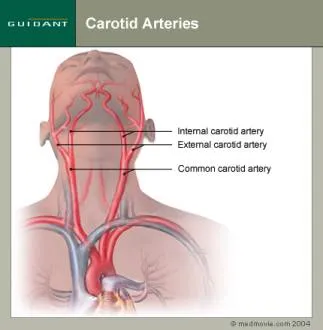
First are the two great common carotid arteries in the neck, one on each side of the windpipe. We'll ignore the external carotid arteries which transport blood to the face and scalp. Our concern is the internal carotid arteries which, between the two of them, carry about a pint and a half of blood a minute to the brain.
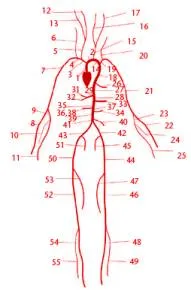
No other organ claims as great a fraction of the five quarts per minute our heart produces when we are at rest. Looking at the arterial road map of the body, the artery to the right leg (numbered 50 below), when the leg is at rest, carries half that amount.
Vascular Dementia
Section titled “Vascular Dementia”Of all the people with senile dementia, only about half have Alzheimer's disease. The second greatest cause of dementia is interruption of blood flow to the brain. This is called vascular dementia from the Latin word for blood or lymph vessel. Impeded blood flow is responsible for about 20 percent of dementia. The vessel does not need to be entirely blocked; narrowing of a major artery such as the carotid, or tinier arteries within the skull, can cause muddled thinking.
Any tissue deprived of circulation will die. Such tissue death is called myocardial infarction in the heart and cerebral infarction (or stroke) in the brain. Just as you can have a "silent" or asymptomatic heart attack, you can also have asymptomatic strokes if they are small enough. These show up on a CT scan or MRI as small white areas. Collect enough of these to impair thinking and we call it "multi-infarct dementia."
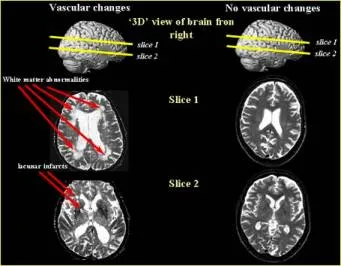
On the right is an MRI of a normal brain. The white areas you see represent normal fluid in the fissures between the gyri. The arrows on the image of the brain on the left indicate abnormal white areas, evidence of small strokes. These cerebral events often fail to cause the typical weakness and numbness of a larger stroke, but when enough occur, thinking becomes more difficult.
Medical Interventions for Foggin' of the Noggin
Section titled “Medical Interventions for Foggin' of the Noggin”A recent study at the Sacred Heart Medical Center in Spokane reported an unexpected finding in 100 patients treated for carotid stenosis (narrowing of a carotid artery.) A team of surgeons there placed stents (flexible mesh sleeves) into affected arteries using catheters threaded up from the groin. One result was that patients had increased memory and mental skills. Some even reported colors were brighter.
Before surgery, these patients had 90 percent narrowing of at least one carotid artery, and though we don't usually test such patients for mental ability, it is clear in retrospect that these people were impaired. The surgery restored normal blood flow and normal thinking ability.
Similarly, when the small arteries within the brain are damaged by high blood pressure, smoking, high cholesterol or diabetes, brain function goes south. One study showed that treatment of high blood pressure reduced the incidence of dementia by 25 percent in just two years. This is because such treatment relaxes the blood vessels, allowing more blood to flow and feed those hungry mitochondria.
Information to Come...
Section titled “Information to Come...”Next month we'll explore more deeply how blood vessels can have trouble over time. One cause is something I am going to call "systemic inflammation," which results in damage to the blood vessels and also damage to the brain tissue itself. Later I'll discuss homocysteine and the nutrients that keep it in check. Homocysteine damage, too, involves not just the blood vessels, but the brain itself.
And Action You Can Take Now...
Section titled “And Action You Can Take Now...”You don't have wait until next month to start doing something. Exercise is a powerful stimulant to blood flow and a prime preventive measure for vascular dementia. It also stimulates new nerve cells to grow in your brain, even when you are older. If you are not already exercising regularly, start slowly but aim for the goal of a vigorous 30-minute walk five times a week. Or substitute some other exercise that raises your heart rate to a safe, moderate level.
The Real Glucosamine Story – Medical Research for Sale?
Section titled “The Real Glucosamine Story – Medical Research for Sale?”If you heard about a recent medical study debunking the value of glucosamine and chondroitin sulfate, you may be interested in the full story behind the headlines and rumors.
What They Said
Section titled “What They Said”On February 23, 2006, the New England Journal of Medicine published a study entitled "Glucosamine, Chondroitin Sulfate, and the Two in Combination for Painful Knee Osteoarthritis." The conclusion read
"Glucosamine and chondroitin sulfate alone or in combination did not reduce knee pain effectively in the overall group of patients with osteoarthritits of the knee. Exploratory analyses suggest that the combination of glucosamine and chondroitin sulfate may be effective in the subgroup of patients with moderate-to-severe knee pain."
What they are saying is that when patients with all degrees of pain were considered, glucosamine and chondroitin sulfate was not statistically better than placebo. However, with moderate-to-severe knee pain, it is effective.
An editorial by Marc Hochberg, MD, titled "Nutritional Supplements for Knee Osteoarthritis-Still No Resolution" appeared in the same issue. His scholarly review did fairly and generously point out a proven benefit of glucosamine. A three year study showed slowing of degeneration of the knee joint, when looked at with X-ray and compared to placebo. However Hochberg concluded
"It seems prudent to tell our patients with symptomatic osteoarthritis of the knee that neither glucosamine nor chondroitin sulfate alone has been shown to be more efficacious than placebo for the treatment of knee pain."
What They Didn't Say
Section titled “What They Didn't Say”What the conclusion neglects to say is that one group of patients in the study was treated with celecoxib, a prescription COX-2 inhibitor that is an accepted treatment for this knee pain with arthritis. So how did celecoxib do in this study? Well, considering patients with all degrees of pain, celecoxib made about 1 out of 10 feel better, and this was statistically significant. But looking at patients with more severe pain, celeocxib was not statistically better. In this group, only those on glucosamine and chondroitin sulfate had significantly less pain and better function than those on placebo.
The Small Print
Section titled “The Small Print”Marc Hochberg, MD, acknowledged that he is a consultant to Pfizer, the maker of Celebrex. Eleven of the authors of the study reported consulting for, lecturing for, owning stock in, or receiving grants from Pfizer.
The Problem with Research Grants
Section titled “The Problem with Research Grants”Last year I heard a talk by Jerome Kassirer, MD, former editor of the New England Journal of Medicine and author of, "On the Take: How Medicine's Complicity with Big Business Can Endanger Your Health." Speaking at the University of Washington, Kassirer reviewed conflicting medical positions on the use of statin drugs to manage cholesterol. The National Cholesterol Education Program recommends that we use statins even more aggressively than we presently do. At the same time, a panel from the University of British Columbia concluded that statins have not been proven to help people who don't already have heart disease. Why the difference? Kassirer pointed out that no one on the University of British Columbia panel had a financial connection with the pharmaceutical industry. Seven of the nine distinguished participants on the National Cholesterol Education Program panel did have such connections.
Examples of conflict of interest abound. However, I believe that medicine's love affair with pharmaceutical agents goes beyond such conflicts. Just to prove a point, a group of researches wrote up a fake research study about medicine X and sent it to two groups of reviewers. For one group they gave medicine X a name that sounded like a pharmaceutical. For the other, they gave it a botanical name. In general, reviewers sent back more favorable reviews to what they thought was a drug and less favorable reviews to what they thought was an herb – despite the fact that the so called "findings" were identical.
I subscribe to The Medical Letter, a publication that accepts no advertising and is supported solely by the dollars of the physicians who subscribe to it. This letter is independent of conflict of interest. Still, I was surprised to see the March 27, 2006 issue begin
"Now that glucosamine and chondroitin, two favorite over-the-counter remedies for painful osteoarthritis of the knee, have been at least somewhat discredited..."
In my opinion this statement reflects the pro-pharmaceutical bias of the profession. This bias is understandable. We doctors have seen what penicillin can do and how chemotherapy can buy cancer patients years of life. But bias, no matter how understandable, can undermine our understanding of the facts.
My Conclusions about Glucosamine and Chondroitin Sulfate
Section titled “My Conclusions about Glucosamine and Chondroitin Sulfate”Glucosamine and chondroitin sulfate do indeed have a pain-relieving effect, particularly for moderate-to-severe pain. The pain relieving effect takes longer to appear than the effect from aspirin, ibuprofen, celecoxib, and other NSAIDS. (NSAID is medical shorthand for NonSteroidal Anti-Inflammatory Drug).
In addition, glucosamine and chondroitin sulfate promote growth of cartilage in the knee, at about 0.1 mm per year (about 1/250 of an inch) The above study, incidentally, is continuing and will report next year on whether or not glucosamine and chondroitin sulfate contribute to restoration of the joint space. They will require twice that rate of improvement as a positive response. Even if glucosamine and chondroitin sulfate fails to pass the standard they have set, the details should be telling.
It seems to me that a remedy that works best when you hurt most is something to be happy with. That's not the time to say "It doesn't work."
More Information Online
Section titled “More Information Online”You can read more about arthritis, glucosamine, and chondroitin, including a price and quality comparison of popular brands, and about this recent New England Journal of Medicine report.
CJK 12/13/06