

January is the month when people flock to gyms and diet programs. I'd like to offer you another way to get a fresh start on health. In this season of the return of the light, I want to talk about the place "where the sun never shines." That's right folks, this issue is dedicated to the lovely, five-foot-long structure that snuggles down in our lower abdomen and has a great deal to do with whether we feel peppy and energetic or sluggish and dull. This month's newsletter is dedicated to the colon and how to keep it chugging happily along.
Colon Disorders
Section titled “Colon Disorders”Unfortunately, a backed-up colon is more common than you might think. In many people who don't think they have an elimination problem, physical examination of the left lower quadrant of the abdomen reveals a descending colon that is palpable and somewhat tender. The patient has normal stools, no awareness of discomfort or problem, yet he suffers from some slowness in the colon. On other occasions, people come with abdominal pain and heartburn that, unknown to them, result from a sluggish bowel.
Colon Disorders are Linked to Diet
Section titled “Colon Disorders are Linked to Diet”Our modern diet puts an increased burden on the colon. The resulting disease can be as mild as occasional constipation, as painful as diverticulitis, or as deadly as colon cancer.
What our diet lacks is fiber. Our ancestors consumed a bulky, fiber-rich diet. Even today, colon disorders are much more common in developed countries than where people eat simple, unprocessed food such as root vegetables, leafy vegetables, and whole grains. In the US, we tend to consume a lot of meat, poultry, fish, eggs, dairy products, and baked goods. These foods have their virtues, but none of them contain significant fiber.
The Benefits of Fiber
Section titled “The Benefits of Fiber”A sluggish bowel can almost always be improved by eating more fiber. Here's why:
1. Fiber keeps the stool hydrated. Dry stool doesn't move very well. Hydrated stool is bulky. The colon can more easily get a grip on it and move it through. Drier stool results in greater pressure inside the colon and the formation of pockets called diverticuli.
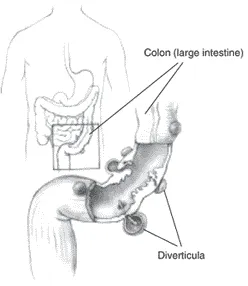
Source: http://www.digestive.niddk.nih.gov/ddiseases/pubs/diverticulosis/#1
Diverticuli are like miniature appendixes, and like the appendix, can become infected, sometimes dangerously so. Best to avoid them altogether by maintaining a high fiber diet.
2. A high fiber diet does more than help promote happy bowel movements. A high fiber diet encourages vital bacteria to grow in our gut. Bacteria in our colon use a fermentation process to turn fiber-based gums and pectins into beneficial nutrients such as butyric acid. Data are conflicting, but some evidence indicates that butyric acid reduces the risk of colon cancer. Don't bother with butyrate supplements; the butyrate has to be produced on-site.
3. Healthy bowel flora provide us with essential vitamin K and biotin.
4. Certain fibrous foods, such as oats, have been shown to reduce cholesterol.
Types of Fiber
Section titled “Types of Fiber”There are two main types of fiber.
1. Insoluble fiber, such as bran, doesn't dissolve in water, but it does help to increase the bulk of the stool.
2. Soluble fiber dissolves in water, and though we humans can't digest it, the beneficial bacteria make good use of it, as mentioned above. Soluble fiber also increases stool bulk, and includes the following substances:
- Arabinose is found in legumes.
- Beta-glucan, in oats, barley and rye, has been shown to reduce the risk of heart disease.
- Gums in beans, rice, barley, oats and seaweed, made into butyrate by bacteria in the bowel, also can reduce irritable bowel symptoms.
- Pectin in fruit, made into butyrate by bacteria in the bowel, reduces absorption of cholesterol.
Fiber in Food
Section titled “Fiber in Food”The best way to obtain more fiber is by eating a diet that is high in fruits, whole grains, legumes, and vegetables. Unprocessed foods tend to be a better source of fiber than processed ones. Whole grains, including brown rice and whole oat groats, do not raise blood sugar as does grain processed into flour. Whole grain bread is healthier than white bread but still a mediocre source of fiber. Juices are touted at healthy drinks but, unfortunately, most of the fiber has been removed. You can see the amounts of fiber in common foods by consulting one of the many fiber content charts on the Internet.
Fiber Supplements
Section titled “Fiber Supplements”Fiber supplements do not replace the many types of fiber listed above and do not substitute for a healthy diet. However, once you have achieved as good a nutritional intake as you can, you may still not be consuming as much fiber as Paleolithic man and you may benefit from a fiber supplement.
Choices of fiber supplements include:
- Psyllium seed husk, available as Metamucil in most of the western world or in bulk at the Food Coop. Metamucil has an orange flavor. This product is well tolerated by most people but occasionally can cause gas.
- Herbal blends such as Rejuve include psyllium along with bowel-active herbs.
- Citrucel is a brand of hydrocellulose fiber supplement that is also easy to take and rarely causes gas. Citrucel is available over-the-counter at the drugstore.
For any of these fiber supplements, start with one tablespoon in water twice a day. Drink it right away or you'll get to observe how much water these absorb and end up with a glassful of gel. Drink adequate water or you may experience abdominal pain as the fiber absorbs water in the digestive tract.
A River Runs Through It
Section titled “A River Runs Through It”Once you increase your fiber intake, it might take a few days for it to penetrate the entire bowel column. I liken the GI tract to a stream. You can improve the health of the upstream area as much as you wish, but until that downstream logjam goes, it ain't gonna flow. So even if a person starts to eat a high-fiber diet, there might be enough of a logjam at the bottom that they will require a laxative just to break things lose and get moving normally again. My favorite laxatives, in ascending order of oomph, used to be prune juice, milk of magnesia (one ounce), or castor oil (four or five teaspoons, best to ask your doctor first). Now my favorite laxative is polyethylene glycol 3350, available as Miralax and various generics. It can take a few days but is relentless in its effectiveness.
The Rectum is a Wonderful Thing
Section titled “The Rectum is a Wonderful Thing”The rectum, an under-appreciated structure, makes up the last six inches of the colon. After some twists and turns, the colon makes a bee line for the exit and it then takes on the Latin name for straight: rectum (as in rectitude).
Normally the rectum is empty and if I do a rectal exam on a healthy individual I will not feel any stool. The way the mechanism works is that the colon will, from time to time, push a quantity of feces down into the rectum. This stretches the rectum, which causes that unmistakable feeling. If we obey nature's call, the stool is passed. Any small amount of remaining stool is pushed back into the sigmoid colon, leaving the rectum empty. Should we not obey nature's call when it comes, the rectum becomes habitually full. Those stretch receptors and their associated reflex mechanisms then lose the ability to function normally. That nice little cycle of empty rectum–full rectum–signal to the brain–emptying process–empty rectum breaks down.
People in this situation report distress from a continued sense of a need to empty their bowels but not being able to. The result can be general misery. It is far easier to obey nature's call and keep the rectum operating normally and happily.
The Underappreciated Anus
Section titled “The Underappreciated Anus”Here is a traditional tale told by Johnny Moses, a Tulalip Native American storyteller raised in the remote Nuu-chah-nulth village of Ohiat on the west coast of Vancouver Island.
Raven gathered the people in the great lodge, complimented them on their many accomplishments and virtues, and pointed out that if only they didn't have that shameful anus beneath their clothing, they would be perfect. So the people gave Raven gifts in exchange for his magical removal of their anuses. Immediately they felt so much cleaner and less embarrassed. The next few days, though, inexplicably, everyone seemed faintly ill-at-ease. Then the people realized their mistake and began searching frantically for the now missing raven.
While the people continue their search, let me point out the wonders of the anus. Consider this: when those stretch receptors in the rectum signal the brain, the rectum may contain gas, stool, or liquid. The anus can tell the difference and sort out what action to take.
Sometimes, though, when the anus is ailing, it cannot do that important job. It may leak. It may hurt. It may be unable to tell stool from gas. The weight loss drug orlistat (Xenical) works by impairing fat absorption. As a result the stool contains excess fat, and this confuses even a healthy anus, which cannot distinguish oily stool from gas, and lets it pass.
When our mothers made us, they made us with an anus. We need to care for it as our mothers did, with nurturing concern and freedom from judgment. Otherwise we'll need, as in the Native American story, to make amends. Only our gifts will not be to Raven to reverse his magic, but to a modern medicine man.
So let us always appreciate our colon, the healthy bacteria it carries, and the anus that bids our stool farewell. Let us treat our personal plumbing well.
New Year's Resolution
Section titled “New Year's Resolution”Easy does it. Rather than a sudden, impossible-to-maintain change, find foods that are rich in fiber that you'll enjoy in your everyday meals and snacks.
Buy fruit and keep it on the table. You'll remind yourself to consume it before it goes bad. Cook a pot of beans, and freeze in portion-size units for last-minute meals. This will make your colon happy. And when Mr. Colon is happy, everybody is happy.