

Frequently Asked Questions About the Winter Flu
Section titled “Frequently Asked Questions About the Winter Flu”How do we prepare for winter with this new flu we discussed last month? Are flu shots really safe? Can’t I fight off the flu on my own by building my immune system up? These are the questions I hear from patients every day. This month I would like to answer some of these questions with my own flu FAQ.
1. Why do they call the Swine Flu H1N1? What do these letters and numbers stand for?
Section titled “1. Why do they call the Swine Flu H1N1? What do these letters and numbers stand for?”You can read the details at http://en.wikipedia.org/wiki/Viral_life_cycle , but to keep it short, a virus uses a surface protein called hemagglutinin (H) to attach to a host cell, which it enters. Once inside, the virus hijacks the cell’s machinery, which then makes many copies of the virus. The many daughter viruses then exit the cell, only to get stuck there again by the hemagglutinin (H), so they use another surface protein, neuraminidase (N), to separate themselves from the host cell. Then they can get away to start afresh. Scientists give numbers to the different kinds of hemagglutinin and neuraminidase, so viruses are typed as H1N1, or H2N3, etc.
In the diagram below the infecting virus attaches with its hemagglutinin at top left, enters the cell, takes over the reproductive machinery in the nucleus (center), and makes many copies that exit at the right and separate from the cell membrane using neuraminidase. The diagram shows just six daughter viruses, but in real life there can be thousands.
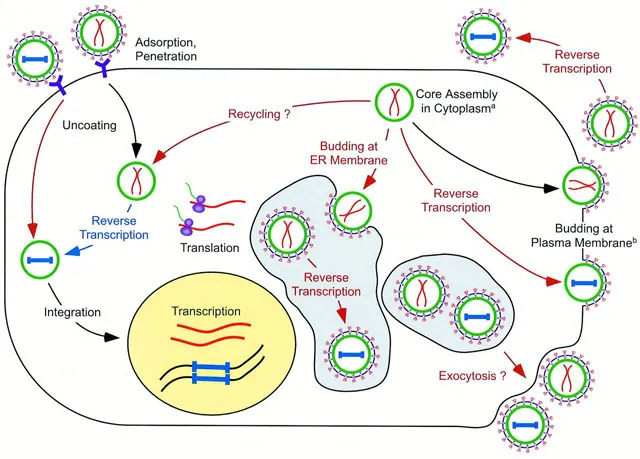
Source: http://www.stanford.edu/group/virus/retro/2004ahmed/HFV.htm
2. Why is there mercury in vaccines?
Section titled “2. Why is there mercury in vaccines?”While vaccines can be packaged in individual dose containers that require no preservative, any clinic, including ours, finds multiple dose vials easier for shipping, take less space to store, cost less, and fit easily into our work-flow. Unfortunately when we are sticking needles, even sterile needles, into these vials, we can introduce contaminants. For this reason all multiple dose vials, whether they contain vaccine or some other therapeutic agent, require a preservative. Vaccines uniquely require thimerosal, a mercury preservative, so as not to interfere with the action of the vaccine. Thimerosol was developed long ago and has long been in use. It may be in your medicine cabinet as a reddish brown material labeled Merthiolate, an anti-infective agent for cuts and abrasions. Currently thimerosol appears in contact lens cleansers, cosmetics, and as a tattoo pigment.1 Back in the 1920s, when there were no preservatives in vaccine, people died from contaminated vaccine. That stopped happening after we began to use thimerosol. There is also another, much less significant source of mercury in vaccine. The virus is grown in chicken eggs, then killed and prepared for use.2 Traces (below our limits to measure amounts) of mercury preservatives remain from this process.
3. Just how much mercury is there in flu shot?
Section titled “3. Just how much mercury is there in flu shot?”There are about 25 micrograms of thimerosal in a flu shot. To put risks in perspective, the major mercury hazard in our environment occurs in industry and in fish, in a form know as methylmercury. Ethylmercury, the form in thimerosal, appears to be less toxic than methylmercury. On a weight basis it contains about half the mercury of methylmercury.3 The ethylmercury in Thimerosol, while it is absorbed and distributed similarly to methylmercury, seems to be excreted much more rapidly.4
But for the sake of illustration, let us consider them similar. This table compares exposures to these compounds.
| Microgram (mcg) | Form | |
| 21,000,000 | thimerosal | fatal dose for average adult5 |
| 5,800,000 | thimerosal | survivable dose for adult male6 |
| 117 | Methylmercury (more toxic) | 7 oz can of tunafish7 |
| 25 | thimerosal | one dose vaccine |
Given a choice of a vaccine containing 25 micrograms of thimerosol, or no vaccine at all, I’ll choose to give my immune system some experience with these viral antigens and accept one sixth of the mercury in a can of tuna fish along with it. While I personally enjoy good health, I don’t want to bring any influenza to my patients and friends.
4. How about the safety of childhood immunizations?
Section titled “4. How about the safety of childhood immunizations?”First, childhood vaccines no longer contain mercury. The Environmental Protection Agency demands a ten-fold margin of safety on top of the current standards, and ordered thimerosol removed from childhood vaccines. The American Academy of Pediatrics reviewed the issue8 and reported that while there was no evidence for harm from thimerosal, it supported the measure because
- Current technology allowed it
- It would reduce lifetime exposure to mercury
- It would improve public confidence in vaccines.
There has been a fear circulating that childhood vaccines lead to autism. Based on my own investigations, I do not believe that to be true. A British study, the third to find no such association, found that early childhood immunization seemed to protect children from developmental delay and ADD.9 The study was not sponsored by industry. I suspect that prevention of childhood illnesses allows better normal neurologic development, not worse.
5. Isn’t the new swine flu shot an experimental, untested vaccine?
Section titled “5. Isn’t the new swine flu shot an experimental, untested vaccine?”The 2009 H1N1 Influenza vaccine has been prepared in exactly the same way as the seasonal influenza vaccine, using chicken eggs. While newer methods appear to be as safe, as well as less expensive and more rapid, those working in this field chose to use the older, slower method to counteract just this objection. Had this strain of influenza shown up just a bit sooner, we would have included it in the seasonal shot. It showed up late, hence the extra effort, and hence the delay in vaccine supplies.
6. Why can’t I just let my immune system take care of this on its own?
Section titled “6. Why can’t I just let my immune system take care of this on its own?”Your immune system develops resistance by getting to know the infecting agent. The little taste provided by the vaccine injection is exactly what it needs to gear up and protect you. If it doesn’t know the invader, it has a hard time protecting you. Take tetanus for example. Skip the tetanus vaccine, get a wound contaminated with the bacteria Clostridium tetani, and your immune system will wake up too late to prevent death. If instead you choose to get the tetanus shot, your immune system is ready and waiting next time you step on a nail. If you are a person who has a day of flu-like symptoms following the influenza vaccination, be aware that your immune system causes those symptoms in the process of developing immunity to the flu. It can also develop immunity without any symptoms.
7. I still don’t want any mercury. Can I get a mercury-free vaccine?
Section titled “7. I still don’t want any mercury. Can I get a mercury-free vaccine?”Monroe Street Medical Clinic does offer mercury-free seasonal flu vaccines. Last spring we put in our order for single-dose vials of mercury-free A/Brisbane/59/2007 (H1N1), A/Uruguay/716/2007, and B/Brisbane/60/2008, (the standard seasonal flu vaccine) prioritized to our patients and frequent fliers. We go to extra effort to obtain this mercury-free vaccine. It is non-refundable and usable for only the current winter season. Some years we’ve wished we had more, one year we had to throw some away. This year our supplies are exhausted. To help us match our order with your needs, this year we are taking $10 deposits in the office to guarantee you access to the 2010 version. Once we run out, we can only obtain the usual mercury-preserved vaccine if we can obtain anything.
The 2009 H1N1 Influenza vaccine is packaged with and without thimerosal preservative, and we have no choice about what we are provided.
Three Things You Can do to Stay Healthy this Winter
Section titled “Three Things You Can do to Stay Healthy this Winter”The blustery cold and damp of winter puts extra stress on your immune system. Here are three things you can do right now to help you stay healthy throughout the season.
1) Take the sunshine vitamin
Section titled “1) Take the sunshine vitamin”The “unrecognized epidemic”10 of vitamin D deficiency takes its toll during the winter. Vitamin D affects over 200 physiologic functions and helps protect us from infection.11 For example, vitamin D induces the production of natural antibiotic substances in our blood stream called human beta-defensins. This interferes with the adhesion of the hemagglutinin on the influenza virus to healthy cells.12 Vitamin D is required for us to produce cathelicidin,13 an immediate-acting antibiotic we make in our skin and white cells. Current research shows that people with lower vitamin D levels develop colds and ordinary flu-like illnesses more frequently than those who are well supplied.14
We evolved making most of our vitamin D in our skin. The only way to get optimal levels of vitamin D is to live in southern latitudes and spend some serious time in the sun. If you live in the North, do not think that by consuming a healthy diet that you can get adequate vitamin D, unless your diet is mainly sun-dried shitake mushrooms, wild-caught salmon, and wild reindeer. In addition, the production of vitamin D in skin diminishes with aging. To maintain a healthy level of vitamin D in northern climes, you need to take supplements.
A reasonable supplemental dose of vitamin D is about 4000 to 5000 units a day in our climate. To put this in perspective, a fair-skinned young adult without sunscreen will produce about 20,000 units in a half-hour summer sunbathing session.15 Clouds, clothing, window glass, aging, dark skin, and the sun low in the sky each prevent production of vitamin D. Excess fat absorbs enough vitamin D to make us deficient. While 4000 units sounds like a great deal, the units are very small, 4000 of them weighing just 100 micrograms, or 0.1 milligram. Your 4000-5000 units are well below what you’d get naturally from the southern sun.
2) Take your Multi-vitamin
Section titled “2) Take your Multi-vitamin”In addition to vitamin D, you’ll benefit from a multiple vitamin. We’ll cover this more completely in a future newsletter, but for now, you need to know that magnesium, for instance, works with vitamin D to strengthen the immune system.16 And when researchers looked at older folks living independently, those who did not take a daily multiple vitamin-mineral were down with some kind of infection about seven weeks of the year, compared to three weeks in a group taking a supplement.17
3) Get enough sleep.
Section titled “3) Get enough sleep.”Satisfactory sleep improves immune function and reduces the incidence of upper respiratory infection. Staying up til 3 am causes a 30 percent reduction in the number of natural killer lymphocytes when measured later the same day, with reduced function of those natural killer lymphocytes still present. As well, the potent immune system stimulant interleukin-2 was also reduced.18
So, get your flu shot, take those vitamins, and enjoy those long winter naps and healthy winter days!
P.S. How to get a low patient-satisfaction score
Section titled “P.S. How to get a low patient-satisfaction score”This emergency-department doctor describes how to get a low patient-satisfaction score at http://www.post-gazette.com/pg/09284/1004304-109.stm.
Footnotes
Section titled “Footnotes”1 http://en.wikipedia.org/wiki/Merthiolate
2 http://en.wikipedia.org/wiki/Influenza_vaccine#Flu_vaccine_manufacturing
3 Atomic weight of mercury is 201, of the methyl group 15, of the methylmercury cation 216.
4 http://www.ehponline.org/members/2002/suppl-1/11-23clarkson/EHP110s1p11PDF.pdf
5 http://pediatrics.aappublications.org/cgi/content/full/107/5/1147
6 J Toxicol Clin Toxicol. 1996;34(4):453-60.
7 http://www.pubmedcentral.nih.gov/picrender.fcgi?artid=1253750&blobtype=pdf
http://www.pubmedcentral.nih.gov/picrender.fcgi?artid=1817718&blobtype=pdf
8 http://pediatrics.aappublications.org/cgi/content/full/107/5/1147
9 http://pediatrics.aappublications.org/cgi/reprint/114/3/584
10 Holick MF. "Evolution and function of vitamin D." Recent Results Cancer Res. 2003;164:3-28.
11 Influenza, in fact, exhibits strange behavior. Given the rapid spread of the 1918 and other influenza epidemics, we’ve assumed it is very contagious. Yet when researchers took sputum and nasal washings from freshly infected influenza sufferers, and swabbed this into the noses and eyes of volunteers, very few of the volunteers became ill. And while measles, chicken pox, and other contagious illnesses spread to about 70% of susceptible family members, influenza does so just 20% of the time. In late 1918, the epidemic hit France, Sierra Leone (Sierra Leone is close to the equator, but vitamin D levels vary there as well) and the USA simultanously. (http://history1900s.about.com/od/1910s/p/spanishflu.htm) Since we had little air travel at that time, how do we explain this simultaneity? The best explanation I have seen, expressed in http://www.virologyj.com/content/5/1/29, is that the virus spreads among asymptomatic people, then remains latent until immunity wanes with falling vitamin D levels and those people become ill.
12 http://www.virologyj.com/content/5/1/29 As well, pathogenic microbes, much like the commensals that inhabit the upper airway, stimulate the production of a hydroxylase that converts 25(OH)D to 1,25(OH)2D, a seco-steroid hormone. This in turn rapidly activates a suite of genes involved in defense.
13 http://www.pnas.org/content/103/24/8913.long
14 Association between serum 25-hydroxyvitamin D level and upper respiratory tract infection in the Third National Health and Nutrition Examination Survey.
Ginde AA, Mansbach JM, Camargo CA Jr.
Arch Intern Med. 2009 Feb 23;169(4):384-90.
Emergency Medicine Network, Massachusetts General Hospital, 326 Cambridge Street, Boston, MA 02114, USA.
BACKGROUND: Recent studies suggest a role for vitamin D in innate immunity, including the prevention of respiratory tract infections (RTIs). We hypothesize that serum 25-hydroxyvitamin D (25[OH]D) levels are inversely associated with self-reported recent upper RTI (URTI). METHODS: We performed a secondary analysis of the Third National Health and Nutrition Examination Survey, a probability survey of the US population conducted between 1988 and 1994. We examined the association between 25(OH)D level and recent URTI in 18 883 participants 12 years and older. The analysis adjusted for demographics and clinical factors (season, body mass index, smoking history, asthma, and chronic obstructive pulmonary disease). RESULTS: The median serum 25(OH)D level was 29 ng/mL (to convert to nanomoles per liter, multiply by 2.496) (interquartile range, 21-37 ng/mL), and 19% (95% confidence interval [CI], 18%-20%) of participants reported a recent URTI. Recent URTI was reported by 24% of participants with 25(OH)D levels less than 10 ng/mL, by 20% with levels of 10 to less than 30 ng/mL, and by 17% with levels of 30 ng/mL or more (P < .001). Even after adjusting for demographic and clinical characteristics, lower 25(OH)D levels were independently associated with recent URTI (compared with 25[OH]D levels of > or =30 ng/mL: odds ratio [OR], 1.36; 95% CI, 1.01-1.84 for <10 ng/mL and 1.24; 1.07-1.43 for 10 to <30 ng/mL). The association between 25(OH)D level and URTI seemed to be stronger in individuals with asthma and chronic obstructive pulmonary disease (OR, 5.67 and 2.26, respectively). CONCLUSIONS: Serum 25(OH)D levels are inversely associated with recent URTI. This association may be stronger in those with respiratory tract diseases. Randomized controlled trials are warranted to explore the effects of vitamin D supplementation on RTI.
15 Altern Med Rev 2008;13(1):6-20
16 McCoy H,Kenney MA. "Interactions between magnesium and vitamin D: possible implications in the immune system." Magnesium Research. 1996 Oct;9:185-203. (Issue number 3) Research reported by Agricultural Experiment Station, University of Arkansas, Fayetteville, USA.. =14860= = Author's abstract: Evidence clearly shows that magnesium and vitamin D [1 alpha, 25-dihydroxyvitamin D3; 1,25(OH)2D3] independently affect numerous aspects of the immune system. Although no reports of interactive effects on components of immunity have been found, there is evidence that the two nutrients interact in other biosystems, sometimes involving calcium. Furthermore, this paper identifies numerous places in common where both magnesium and vitamin D reportedly affect immune function. Fundamental sites for possible interaction within the immune system include cell transformation, regulation of the cell cycle, stabilization of nuclear DNA/chromatin, production of reactive oxygen species (ROS), and effects on enzymatic and hormonal actions. The presence of different functional, chemical forms of both of the nutrients within biological systems, and the availability of synthetic drug relatives of both to introduce into such systems, complicate interactive studies because such differing forms may not necessarily interact similarly or interact at all within the immune system or elsewhere. Regardless, there are compelling reasons to believe that examining interactions between magnesium and vitamin D within the immune system could prove rewarding, especially since the physiological statuses of both nutrients in human populations are less than optimum. Such human populations include the elderly whose immune function may be compromised.
17 Citera G,Arias MA,Maldonado-Cocco JA,Rosemffet MG,Brusco LI,Scheines EJ,Cardinalli DP. "Effect of vitamin and trace mineral supplementation on immune responses and infection in elderly subjects" Lancet. 1992 Nov 7;340:1124. In this randomized controlled trial, 96 independently living elderly subjects were given physiologic amounts of multiple vitamins and trace elements or placebo. The treated group were ill from infection 23 days per year compared to 48 days in the control group. Cells and substances associated with immunocompetence were also increased in the study group. The supplement contained vit A 400 retinol equivalents, beta-carotene 16 milligrams, thiamine 2.2 milligrams, riboflavin 1.5 milligrams, niacin 16 milligrams, pyridoxine 3 milligrams, folate 400 micrograms, vitamin B12 4 micrograms, vitamin C 80 milligrams, vitamin D 4 micrograms, vitamin E 44 milligrams, iron 16 milligrams, zinc 14 milligrams, copper 1.4 milligrams, selenium 20 micrograms, iodine 0.2 milligrams, calcium 200 milligrams, and magnesium 100 milligrams. The placebo contained calcium and magnesium.
18 The Promise of Sleep. William C DeMent pages 264-9.