

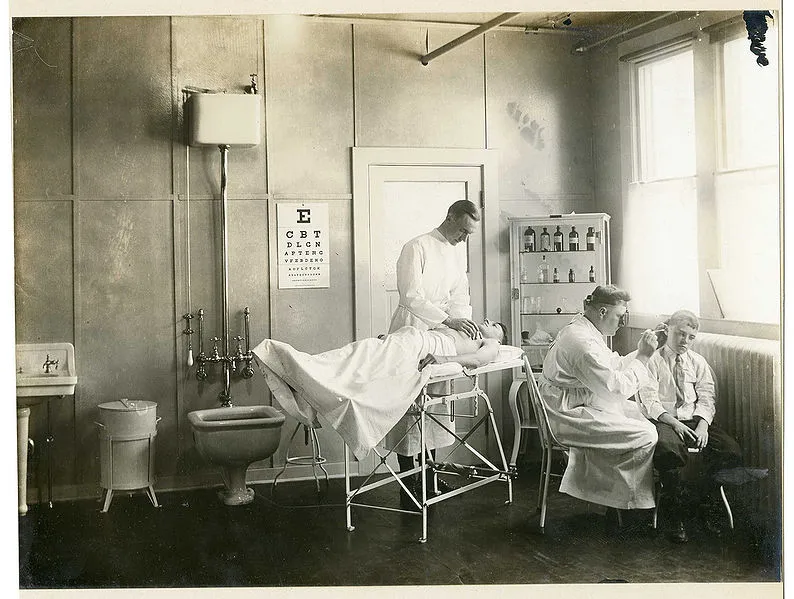
Photo Courtesy of Otis Historical Archives Nat'l Museum of Health & Medicine
Why We Love Routines
Section titled “Why We Love Routines”We humans find comfort in routine. Children go to bed more easily when parents read a story, tuck in the sheets, and turn out the lights. My Texas aunts would add "Good night, sleep tight, and don't let the bedbugs bite." And we adults, even medical authorities, find comfort in routines. Hence the annual physical, the routine mammogram, the colonoscopy, etc. It's routine; it's comfortable; it's certainly easier than trying to understand the complexities of one individual and their health.
Come into the examining room with me where Peggy has some questions. She's 37 and she decided to come to me for her annual check-up. Before the exam she tells me her main worry has to do with her breasts. She grows lumps much more often than other women and her mammograms show worrisome patterns, so she has had many breast biopsies. For some of these, her doctors used just a needle, while for others they would remove the entire lump. She's concerned that at this rate she won't have any breasts left by the time she turns fifty.
Does she have a strong family history of breast cancer? No, she says.
We talk this over long enough to decide that she just doesn’t fit into our usual system for breast cancer detection. And our current system provides no guarantee that, even with annual mammograms, a woman will not die of breast cancer. At best, that system can lower the death rate a few percentage points.
Given those facts, Peggy decides not to follow the usual routine. She’ll continue with self-exam, she’ll continue with periodic physician exams, but absent more definitive abnormalities, we’ll dispense with the routine protocol.
Routine Physical Exam
Section titled “Routine Physical Exam”Routine physical examinations also seem like a great idea. Detect problems before they cause us harm. When we compare the actual benefits to the cost, however, we run into trouble. Yes, a colonoscopy detects and removes worrisome polyps and small cancers, but the cost in money and complications makes it less attractive than a simple stool test.
Yes, when listening to someone's heart at a routine physical examination, I've picked up problems that needed attention. But I remember well 42-year-old Tom, who lived in Milwaukee. Tom had an unusual heart murmur so I did an EKG. Normal ... but, what is that slight ST segment elevation? So I asked the cardiologist, who agreed, this was almost certainly a normal EKG, and the murmur not that worrisome, but gee, we're not quite sure. So he did a stress test, normal, but... Finally he did an angiogram, which showed, without a doubt, just what you'd expect in 42 year old healthy man, normal arteries without narrowing or blockage.
In retrospect, we let ourselves get off on a wild-goose chase, even to the point of running tubes up into Tom’s heart. We got away with it, as we usually do, but was the risk really worth it?
For these reasons, physicians more and more agree that a routine annual physical for adults is not an unalloyed good.
Sure, parts of the exam, such as the blood pressure check and the cancer screening, are useful. But routinely listening to everyone's heart, examining everyone's lungs, palpating each abdomen, just doesn’t make sense.
Checklists - A Good Routine
Section titled “Checklists - A Good Routine”Let's not confuse routines with the check-lists used before surgery, or the check-lists used before getting a CT scan or MRI. These check-lists prevent surgical errors and unnecessary imaging studies. They are best employed by alert people who remain always aware of any special signs or symptoms of their patients that might require going beyond the check-list. Their use exemplifies intelligent design.
However the word "routine," as in routine physical exam, can connote procedures done without thinking. We need to do better by Peggy and Tom than our "routines" are doing.
Coming Next Month
Section titled “Coming Next Month”Next month we’ll talk about a better plan, the personalized check-in with your physician at an interval appropriate to you.
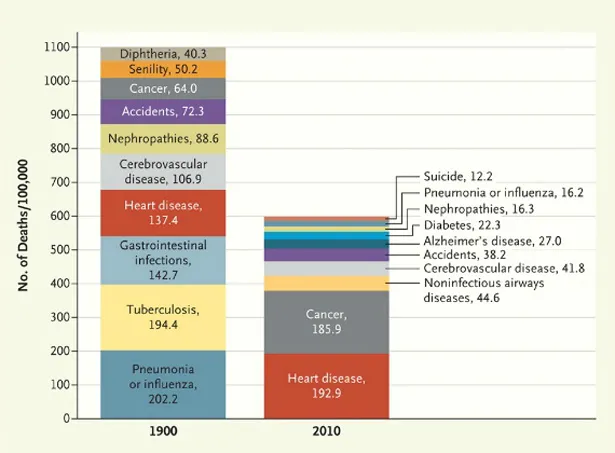
Until then, ponder this chart from the New England Journal of Medicine regarding what it is that you and your doctor are trying to detect and prevent, and how that has changed over the decades.
Source: http://www.theatlantic.com/health/archive/2012/06/chart-what-killed-us-then-and-now/258872/