

How to Get Well
Section titled “How to Get Well”The people I see who recover from difficult illnesses are those who are comfortable with complexity. They have the self-confidence to tolerate ambiguity and the patience to try more than one thing. Let me tell you the story of Audrey, a smart and thoughtful civil engineer with a lot of challenges.
Audrey – It started in the Sinuses
Section titled “Audrey – It started in the Sinuses”When I first saw Audrey, she had suffered from a long series of sinus infections. Her provider prescribed antibiotics – first the generics, then the costly ones.
Her health insurance covered those visits well, but the infections kept coming. Not satisfied, she did some research on the Internet and after the sixth infection, decided to pay us a visit. We suspected allergies, started her on allergy treatment, and her infection frequency diminished dramatically. When symptoms occurred, she was able to treat them at home with allergy medications we made sure she kept on hand.
Humans are Complex
Section titled “Humans are Complex”Humans are complex creatures, both emotionally and physiologically. In this universe an amazing array of things can go wrong. When a doctor is working with the patient, she must keep in mind many factors:
- how the body is structured (anatomy and histology)
- how the healthy body works (physiology and molecular biology)
- how the body operates when it is sick (pathology and pathophysiology)
- human hopes, fears and emotions
- medications (pharmacology)
- And more… such as what the insurance company will understand and therefore pay for.
Audrey's Stomach
Section titled “Audrey's Stomach”Not long after Audrey's sinuses cleared up, her stomach began to hurt. Her provider tried various treatments, then referred her to a gastroenterologist. An endoscopy showed that she had an inflamed duodenum. Audrey began taking a high dose of a proton pump inhibitor (PPI) and her pain disappeared. Once again she did some research on her own and learned that PPI's increase the risk of fracture, can lower levels of vitamin B12, and interfere with the absorption of certain minerals such as potassium and magnesium leading to irregular heartbeat and other problems.
Fatigue
Section titled “Fatigue”Unfortunately, there's more to Audrey's story. She became fatigued, a bit anxious and depressed, and had some muscle cramps and aches. Her sleep was not as easy as it had been. And after meals, her upper abdomen seemed to bubble like a shaken bottle of Coke.
Once again Audrey hit the Internet. She read all she could and learned that there are many reasons she might be suffering as she was. One or several of an amazing array of things could be going wrong. Audrey didn't know whether her symptoms might signal serious illness and death, or whether they should simply be ignored and pushed through.
After realizing she was thoroughly confused by what she read, this time she by-passed her insurance-covered provider and came to our clinic first.
Complexity and Self-Confidence
Section titled “Complexity and Self-Confidence”Before continuing with Audrey's story, I'd like to point out that she was unusually comfortable dealing with complexity. That requires both self-confidence and the ability to impartially observe results. Cultural anthropologist Dietrich Dorner in his book "The Logic of Failure" describes studies[1] where people are challenged to operate computer-simulated factories, agricultural communities, cities, etc.
Dorner found that that people with less self-confidence have trouble accepting they may have done the wrong thing on their first try. They keep doing similar things over and over and they keep failing. If we don't inquire about the results of our actions, we may not solve the problem.
Audrey was different. As a civil engineer, her work decisions faced analysis and evaluation by her peers. She was used to feedback and viewed it as valuable. She understood the need for trial and observation in her medical care.
As I sat with Audrey and worked with her through the most likely causes of her symptoms, she understood when I did not give her a neatly packaged answer at the end of the hour. She was comfortable with ambiguity. She could hold opposing ideas in her mind without anxiety.
Trial and Observation
Section titled “Trial and Observation”When I asked Audrey about her “bubble" response to different foods, it became clear that her abdomen seemed to bubble only after carbohydrates. She could eat a piece of meat with no problem at all.
A complete investigation of every possible medical condition that could be causing her symptoms would cost tens of thousands of dollars and a great deal of time. I told her the best course was to perform some initial tests, to make some initial interventions, observe the results, and make adjustments based upon her individual response.
We started with a series of magnesium injections, as PPI's can lower magnesium and that can result in cramps and emotional changes. Because magnesium is a laxative, most of us can only take it in doses so low that relief requires months. A series of injections would tell us within a couple of weeks whether we are going to succeed with magnesium supplementation. Audrey's muscle cramps disappeared within a week. Success!
Our initial laboratory investigation looked at vitamin B12 and gluten sensitivity. Both tests were normal. Because the standard vitamin B12 lab tests can be falsely normal, and because the definitive tests, homocysteine and methylmalonic acid can cost over $400, together we decided to give her a therapeutic trial of vitamin B12 and folic acid.
This failed.
Patience Furthers
Section titled “Patience Furthers”Audrey realized that the first, second, third or fourth attempt to remedy an illness, even if non-productive, were still worth the effort. For example, now we knew, and it had cost us little, that B12 deficiency wasn't causing her symptoms.
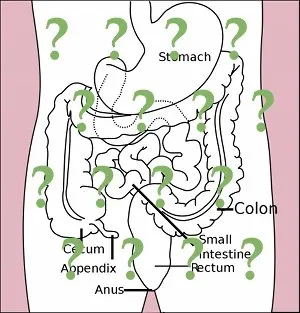
Next I gave Audrey my "gastrointestinal tract" spiel. The gastrointestinal tract is much more a biochemical, microbiological and fermentation factory than it is a series of pipes.
Putting tubes down into the stomach or up from below into the colon sometimes will show us a cause for the patient's symptoms, but frequently will not. Audrey's endoscopy, for example had shown inflammation in the area of the duodenum, but not the reason for it.
We have a number of stool tests that will look at the function of the G.I. tract. Undigested food fibers indicate poor function of the stomach. Chemical tests can tell us something (if we are lucky) about function of the pancreas, the bacteria/human interaction in the G.I. tract, G.I. inflammatory processes, and other factors. Microbiological tests can tell us about the very important bacterial community within us.
I told Audrey it made most sense to limit ourselves to one of those tests, a breath hydrogen test. This test could tell us the likelihood of a condition called small intestinal bacterial overgrowth, or SIBO.
The Nuances of Digestion
Section titled “The Nuances of Digestion”Our stomach acid kills most of the bacteria that we eat. Normally our small intestine harbors few bacteria. When the small intestine is invaded by unsuitable bacteria, these bacteria will ferment carbohydrates, creating gas. People tell me "it doesn't make sense, I eat healthy foods such as beans or rice, and my stomach goes crazy."
Audrey's breath hydrogen test was positive. While I had previously dissuaded Audrey's use of antibiotics for her sinusitis, now I told her that we needed them for her gut. True, we did not know exactly what species of bacteria was where it shouldn't be, and our breath hydrogen test was only indirect evidence. Also every time we use antibiotics, we increase the risk of some detrimental alteration of the normal happy human/bacterial ecosystem that walks to work in our shoes every day.
Audrey thought it over, asked about possible side effects, pondered the risk vs. benefit, and decided to go ahead.
Both of us knew that every time we try something, we succeed or fail, and thus we learn something. She started a week long course of amoxicillin/clavulanate and lo and behold, the Coke bottle in her tummy disappeared.
Audrey was still a little tired. We decided to give her some time. That was what it took. Over the next two months every symptom disappeared. We then started her on some slippery elm with licorice as an alternative means of calming her stomach and over the next month she was able to taper and discontinue her proton pump inhibitor.
Whether the proton pump inhibitor set off the small intestinal bacterial overgrowth we can't be sure. It is hard to always pin down causes in the complex emotional/physiologic/microbiological system we call a human being.
Getting Well
Section titled “Getting Well”Audrey's happy outcome was the result of our partnership in her healing. Although I am a trained and experienced physician, I couldn't have gotten these results if she had given up. Instead she was persistent, curious, and dedicated to her own healing.
I invite you to take up the cause of your own health and happiness with the same patience for trial and error and the same calm curiosity.
Endnotes
Section titled “Endnotes”[1] In these simulations, people are given an opening scenario of factory production, wages, sales, production quotas,, etc., asked to make adjustments to improve outputs (profits, worker satisfaction, company strength, etc.), and then are shown the likely outcome of their decisions by the computer. They are then asked to make further adjustments and this process continues through 10 or 20 periods of time. As it turns out, most people make bets on various remedies the first time around and do not adequately figure out why they did not work. It turns out that few of us humans have the skills to observe the results of an initial input and intelligently adjust our response in such a way as to make a factory, agricultural community, or other sizable human endeavor function productively.