


Recently I received this letter asking about the so-called Alkaline Diet.
Hi Dr. Rienstra,
What do you think of the theory that my symptoms, allergic inflammation, no energy, just feeling crummy, etc., could be caused or aggravated by acidosis? Do you agree with the idea that it is best to keep the body more alkaline to reduce inflammation and to improve bone health?
Thanks for your help.
JB
Alkaline and Paleolithic Diets
Section titled “Alkaline and Paleolithic Diets”People frequently ask me about special diets, and one that's been coming up recently is the "Alkaline" or "Paleolithic" diet. I say "one diet" because both are virtually the same. The reasoning also overlaps quite a bit, so I will consider them together.
The theory behind the Paleolithic Diet is that our metabolism and physiologic processes evolved when we were eating much differently than we do today. Moreover, proponents argue, the diseases we suffer in the United States, such as colon cancer, diabetes, hypertension, gout (to name a few) do not seem to afflict people in less economically developed circumstances.
Maybe it's our relative lack of dietary fiber, our nutrient poor, processed food, our excess of sugar and sodium. Students of the Paleolithic diet tell us that these foods result in excess metabolic acid production. That isn't the only problem with the modern diet, but it's one I get asked about a lot, so let's discuss it.
Paleolithic Versus Modern – What's the Difference?
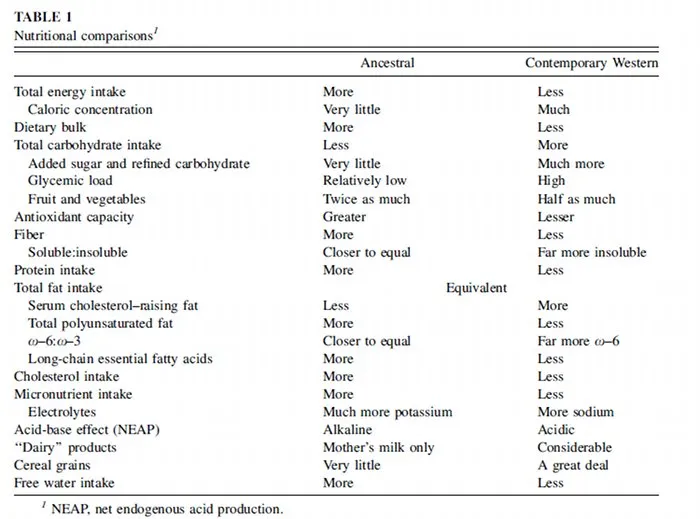
Section titled “Paleolithic Versus Modern – What's the Difference?”Before we go on, let's look at the diet under discussion. This table, from an article in the American Journal of Clinical Nutrition1 , compares the diet we evolved on with the diet we eat today in the West.
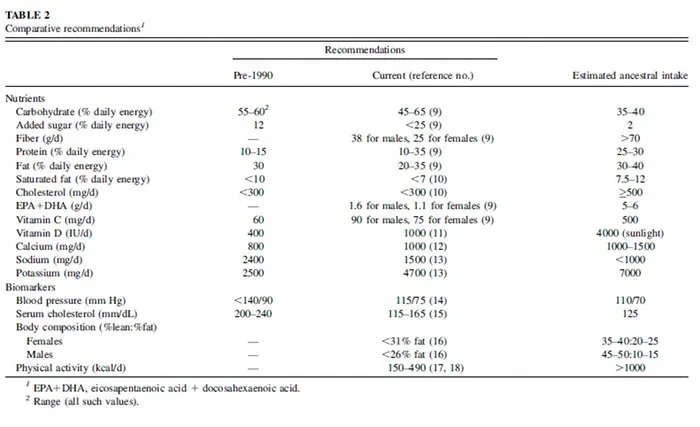
This next table2 compares the nutrient value of the nineteenth century diet with that of today and of Paleolithic times.
Acid/Alkaline Theory
Section titled “Acid/Alkaline Theory”Now, when we metabolize modern foods, we produce more acid than in Paleolithic days. Whereas we used to produce more alkaline urine, most often now we pass more acid. So, why should we care about the Ph of our PP?
One reason is that this more acidic urine carries critical minerals, such as potassium, magnesium, and calcium out of the body.
Less potassium = higher blood pressure, less stable heart rhythm, more muscle cramps.
Less magnesium = all of the above, plus headaches and metabolic problems.
Less calcium = more osteoporosis, disturbance of hormones governing vitamin D and phosphorus.
Now, before you go put this on a billboard, you need to know we're still working this out. For example, the link between urinary calcium loss and osteoporosis remains weak.3
The Scientific Details
Section titled “The Scientific Details”What matters in this discussion is not how an acidic a food is, but whether the metabolism of that food results in acid production in the body which must be corrected by the lungs or kidneys. The technical term is Net Endogenous Acid Production, abbreviated NEAP. Oranges, for example, show an acid pH (citric acid, anyone?), but they result in more alkaline urine. In addition, NEAP does not correlate cleanly with urine acidity. Individual variation is huge, individual abilities to compensate for changes in diet are huge, and prediction of individual outcomes is a nightmare.
My Prediction
Section titled “My Prediction”The acid/alkaline theory still inspires much research. I personally think it will prove to be too simple—many proponents neglect the role of phosphorus. We are mostly composed of phosphorus, actually, most of which, along with calcium, we carry in the bones of our skeleton. We can't live without it.
The trouble is – we're getting too much. Check the labels in your refrigerator and pantry--the odds are that most list some form of phosphate, added for flavoring, mouth-feel, or as a preservative. Phosphates are phosphorus salts and the FDA allows over three hundred forms of them in processed foods. All of them can contribute to calcium in the arteries. Many but not all will acidify the urine. And all can influence our production of vitamin D, our production of calcium-critical hormones, and our handling of calcium, magnesium, and potassium.
Each one of these factors materially influences how long you are going to live and how well you are going to feel. Potassium intake alone, as we discussed in our series of newsletters two years ago, critically influences blood pressure.4
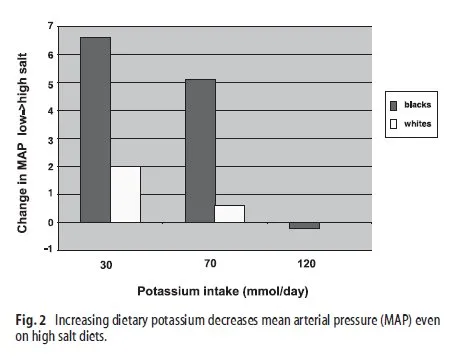
And to go back to the Paleolithic angle, people on a more alkaline diet are also less likely to develop high blood pressure. (Chart above)
Next Month – More on the Paleolithic and Alkaline Diets
Section titled “Next Month – More on the Paleolithic and Alkaline Diets”More time and research stand in the way of a conclusive ending for the Paleolithic and Alkaline Diet story. Still, if you'd like to bend your diet in that direction, next month I will continue my analysis of these diets and give my recommendations.
Open House: Thirty Years in Port Townsend!
Section titled “Open House: Thirty Years in Port Townsend!”This September marks our thirtieth continuous year here in Port Townsend. You can read more here. We invite you to an open house at our newest office here at 708 Kearney Street, on Thursday September 19th from 4 to 7 pm. We'll give you a tour and let you browse some healthful snacks!
Endnotes
Section titled “Endnotes”[1] Diet-dependent acid load, Paleolithic nutrition, and evolutionary health promotion. S Boyd Eaton, Melvin J Konner, and Loren Cordain. Am J Clin Nutr 2010;91:295–7.
[2] Diet-dependent acid load, Paleolithic nutrition, and evolutionary health promotion. S Boyd Eaton, Melvin J Konner, and Loren Cordain. Am J Clin Nutr 2010;91:295–7.
[3] Meta-analysis of the quantity of calcium excretion associated with the net acid excretion of the modern diet under the acid-ash diet hypothesis1–4 Tanis R Fenton, Michael Eliasziw, Andrew W Lyon, Suzanne C Tough, and David A Hanley ABSTRACT Background: The acid-ash diet hypothesis of osteoporosis suggests that acid from the modern diet causes a demineralization of the skeleton, and mobilized bone calcium is excreted. A systematic approach has not been used to summarize the findings of the numerous studies about the hypothesis. Objectives: The purpose of this meta-analysis was to estimate the quantity of net acid excretion and calciuria associated with the modern diet, to assess the association between acid excretion and calcium excretion, and to assess the influence of urine preservatives on calcium measurement. Design: We systematically searched for trials of the acid-ash hypothesis and conducted a meta-analysis. Results: Twenty-five of 105 studies met the inclusion criteria. The estimated quantity of net acid excretion from the weighted average of the control diets from 11 studies was 47 mEq/d. The increase in urinary calcium with a change in renal net acid excretion depended on whether the urine was acidic or alkaline (P0.001).A significant linear relation was observed between net acid excretion and calcium excretion for both acidic and alkaline urine (P 0.001). The estimated change in urine calcium associated with a change of 47 mEq of net acid excretion in acidic urine was 1.6 mmol/d (66 mg/d) of calcium. Conclusion: Evidence suggests a linear association between changes in calcium excretion in response to experimental changes in net acid excretion. However, this finding is not evidence that the source of the excreted calcium is bone or that this calciuria contributes to the development of osteoporosis. Am J Clin Nutr 2008; 88:1159–66.
[4] Diet, evolution and aging: The pathophysiologic effects of the post-agricultural inversion of the potassium-to-sodium and base-to-chloride ratios in the human diet
Eur J Nutr 40: 200–213 (2001)