

Review - or The Perils of Pauline's Brain
Section titled “Review - or The Perils of Pauline's Brain”In previous exciting newsletters you saw how the very structure of the brain, with its complex web of tiny nerve tendrils, creates a massive appetite for energy. You were appalled to see the damaging consequences of producing that energy, and you applauded the nutrients that fight endlessly to protect your brain from damage. Last month you shuddered to see how impairment of blood flow brings the magnificent machinery of your brain to its knees. Stay tuned, now, as medical detectives track a leading villain in that sneaky gang to his lair - the villain we call "microinflammation."
What is Microinflammation?
Section titled “What is Microinflammation?”Inflammation is the body's response to infection or irritation. We are most familiar with inflammation as the redness, swelling, warmth, and pain that occur with localized skin infections. Doctors use the Latin ending '-itis' to indicate inflammation, as in appendicitis or meningitis. Inflammation can also occur without microbial invasion, as with arthritis, tendonitis, or gastritis.
Looking closely at all these conditions, we discover that white blood cells are involved, and they coordinate their activity by signaling each other with chemicals we call cytokines. These chemicals signal the white cells to attack invading microbes or to gather around a splinter to float it to the surface of the skin.
We now know that there are low levels of these signals all over the body at all times. They are part of the background state of alertness of the immune system. Scientists call this condition by various names, including microinflammation or chronic systemic inflammation.
There are many similarities between background microinflammation and the stress response. In fact each can stimulate the other. When we are stressed, chemical signals multiply and our state of alertness increases, but there is a price to pay. Consider how our country as a whole responded to the stress of 9/11. Protective measures at airports and military bases provided not just readiness for response, but also an economic cost and a "wearing out" of the resources involved. Similarly, the state of alertness or inflammation involves a cost to our bodies - it wears out our defenses and makes us more prone to disease.
C-reactive protein
Section titled “C-reactive protein”You may already have heard of C-reactive protein (CRP) as a risk factor for arteriosclerosis. CRP is one of the signaling molecules. Here is a picture of it
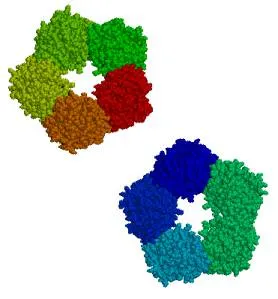

Higher levels of CRP in the blood indicate greater degrees of microinflammation, or higher degrees of physiologic stress. People with higher levels of C-reactive protein are more likely to suffer heart attacks and stroke. Scientists can measure many other inflammatory signals, such as the cytokines mentioned above, but the CRP test happens to be commercially available at your doctor's office.
Microinflammation damages the brain in two ways. This month we'll show how microinflammation damages the arteries that sustain brain function. Next month we'll show how microinflammation damages neurons directly.
How Microinflammation Clogs Arteries
Section titled “How Microinflammation Clogs Arteries”Twenty percent of people with dementia have impaired blood flow to the brain. The most common cause of impaired blood flow is damage to the arteries. All blood vessels are lined by special cells called endothelial cells (collectively endothelium).
The endothelium is just one cell thick, and we met it briefly when discussing the blood-brain barrier earlier. It is an organ in itself, lining the heart and every artery, capillary, and vein. Like any organ, it ages and can be damaged. Microinflammation is a major player in causing this damage. The steps are these.
- Excess cholesterol in the bloodstream collects in the endothelium.
- Some of that cholesterol is oxidized, which adds to the usual background level of inflammatory signals. If this rises above a certain threshold, the endothelium becomes sticky, attracting white cells as shown below.
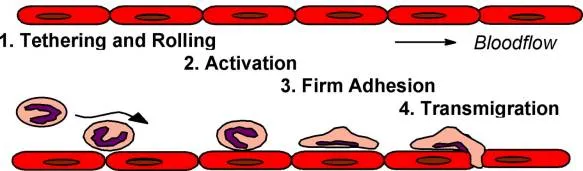
The white cells pass between the endothelial cells to clean up the oxidized cholesterol. In this view below, we are looking at a cut section of an artery; the endothelium is the red lining. The white cells have been activated by inflammatory signals and are beginning to migrate through the endothelium.
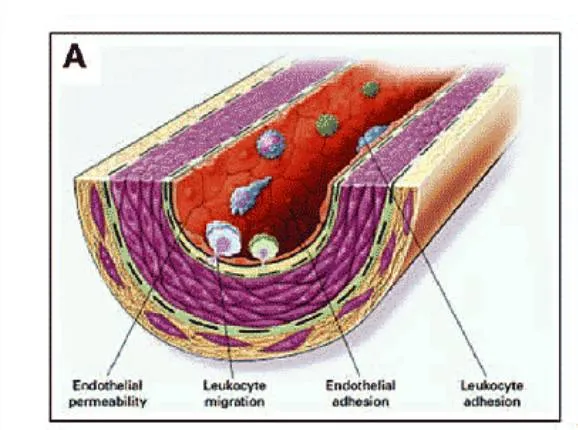
With heightened microinflammation, this first response can become self-perpetuating. The more damage that occurs, more inflammatory signals are sent, and so on. Just as nervous cops at a brawl send for backup, more signals go out and more white blood cells arrive.
What we end up with is arteriosclerosis, the hardening of the arteries associated with heart attack, stroke, and vascular dementia.
Here's how it happens. When that microinflammatory process becomes self-perpetuating, the area between the endothelium and the elastic/muscular coat of the artery becomes swollen with white cells engorged with oxidized cholesterol, called "foam cells," illustrated below.
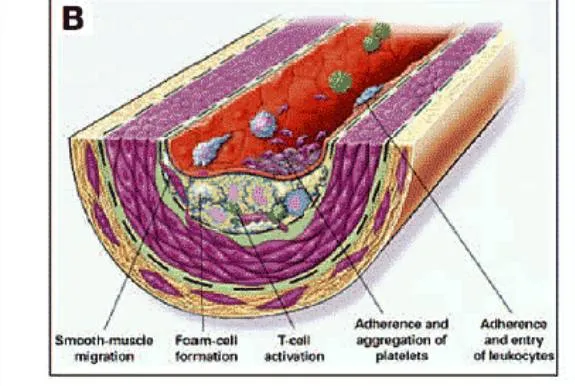
In panel B above, smooth muscle cells have responded to the inflammatory signals by migrating out into the plaque. While the artery is narrowed by about 25%, the endothelium is intact so blood flows past in a normal fashion. At this point, there will be no symptoms and no impairment of the heart or brain.
Depending on the general level of microinflammation, blood sugar levels, cholesterol levels, and other factors, this particular area of plaque may stop at this stage or continue to grow. With sustained insult, the process continues, as shown in panel C below. More white blood cells have been attracted. These cells are called macrophages before they have engulfed oxidized cholesterol. After they consume oxidized cholesterol, they take on a foamy appearance and are called foam cells. Eventually the foam cells die and contribute to dead or "necrotic" tissue within the arterial wall. The artery is under continual stress from the pulsing pressure of the blood, so smooth muscle cells (here colored purple) will collect under the endothelium. This "fibrous cap" walls off this soft and weakened necrotic area.
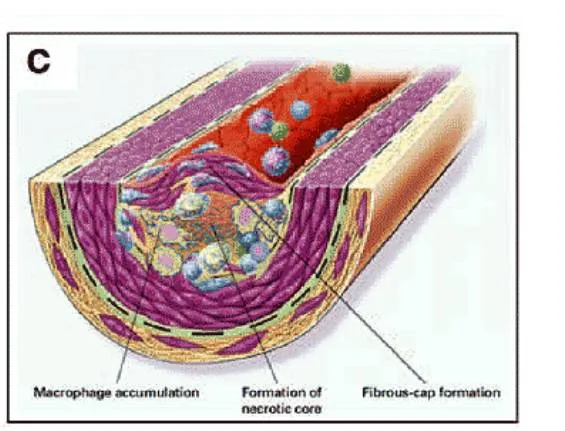
In panel C, the artery is over 50 percent occluded. Were this to happen in a carotid artery feeding the brain, we would experience memory loss as mentioned last month.
Panel D shows the final disaster. The tiny blood vessels within the plaque break and bleed, further enlarging the plaque. Microinflammatory signals lead to dissolution of part of the fibrous cap covering the diseased plaque. The endothelium ruptures. When the tissue juices from within the plaque hit the blood, a clot forms. (See "How Blood Clots")
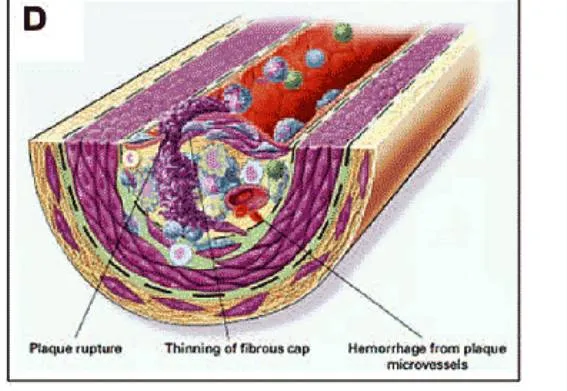
The vessel is completely occluded. If this is a small vessel within the brain, the person will not notice, but a few IQ points are forever gone. If it is a large vessel, the person will have a heart attack or a stroke.
What Causes Microinflammation
Section titled “What Causes Microinflammation”The following factors contribute to microinflammation.
- Higher levels of C-reactive protein in the blood.
- Eating overly rich food - Trans fats disrupt normal structure and function of the cell membrane the endothelial cells. Sugars of all kinds contribute to microinflammation.
- Inadequate sleep – which increases levels of adrenalin, which enhance microinflammation.
- A surplus of worry or feelings of powerlessness. (See "Stress, Microinflammation, and Aging").
- Exposure to radiation or pollution, including smoking. (See "Cigarettes").
- High blood pressure – by mechanically stressing the arteries, increases free radical formation and inflammatory signaling.
Damage to the blood vessels occurs in different areas of the body in different people. When it occurs in the arteries supplying the brain, it contributes to dementia or to a stroke. Wherever it occurs, it involves an inflammatory response related to our general response to stress.
Have you ever wondered why some people with high cholesterol fail to develop arteriosclerosis? It is probably because they have lower background levels of inflammation, as well as other factors that inhibit the process from occurring. On the other hand, people with higher background levels of inflammation can develop arteriosclerosis with lower levels of cholesterol.
What You Can Do
Section titled “What You Can Do”Although microinflammation has a nasty habit of becoming self-perpetuating, there are things you can do both to prevent and to curtail it.
Exercise
Section titled “Exercise”Evidence is overwhelming that exercise reduces the inflammatory background signals in our body, including those in our brains. This is one reason why study after study shows that people who get physical exercise develop dementia less often.
Stay lean
Section titled “Stay lean”Evidence is overwhelming that obesity increases the inflammatory background signals in our body, including our brains. Fat cells produce many inflammatory substances, including CRP. This is one reason why study after study shows that people who are obese develop dementia more often.
Go to bed
Section titled “Go to bed”Evidence is overwhelming that adequate sleep reduces the inflammatory background signals in our bodies, including our brains. This is one reason why study after study shows that people who sleep well develop dementia less often.
Don't smoke
Section titled “Don't smoke”Cigarette smoke and many other pollutants increase the microinflammatory response, not just in the blood vessels but everywhere else as well.
Get Your Vitamins
Section titled “Get Your Vitamins”One study found that vitamin C reduced microinflammatory damage to the endothelium. Zinc also helps protect the membrane from this damage, as well as calming the inflammatory response of these cells.
Eat Your Veggies
Section titled “Eat Your Veggies”Evidence is overwhelming that the micronutrients in our food reduce the inflammatory background signals in our body, including our brains. This is one reason why study after study shows that various micronutrients reduce our likelihood of developing dementia. Flavonoids in foods, for example, inhibit inflammatory enzymes and prevent oxidative damage to blood vessels and, as we'll learn next month, to specific structures in the brain. Of the some 5000 flavonoids in nature, we know of the biologic functions of just a few, but they are generally vital to our health. Many of these flavonoids give color to plants, as in peppers, tomatoes, and the red tint at the base of spinach stems. Give yourself a variety of colors on your plate!
Avoid Junk Food
Section titled “Avoid Junk Food”Shun the bad fats; eat the good. Omega three fatty acids are vital to reducing inflammation. Sugars are a major contributor to microinflammation, as you'll learn next month.
Nutritional Dispensary now Not for Profit
Section titled “Nutritional Dispensary now Not for Profit”Our Nutritional Dispensary is offered to complement our practice, as a not-for-profit service. It is our goal to make top-quality supplements affordable for our patients, providing you with the best supplements we can find, near our break-even point. Patients receive a 10 percent discount, with a further 5 percent discount available to anyone purchasing over $100 in supplements. Profit netted from the dispensary is donated to United Good Neighbors of Jefferson County (UGN) at year's end. Financial reports on the Nutritional Dispensary will be published semi-annually in this newsletter.
Coming Next Month
Section titled “Coming Next Month”Next month we will talk about how microinflammation directly affects the neurons in the brain. We'll also address another major twenty-first century cause of microinflammation, over-consumption of sugar.
CJK 12/13/06