

Rosa's Dilemma
Section titled “Rosa's Dilemma”Rosa slumped in her chair as she told me that the news from her oncologist was not good. While the oncologist thought Rosa had a decent chance for remission, she could not guarantee this. Rosa's neighbor had told her that alkaline water could help. Her neighbor promised that if Rosa would only buy an expensive machine to produce this water, she could rid herself of cancer. What did I think about this?
Paleolithic and Alkaline Diet
Section titled “Paleolithic and Alkaline Diet”In last month's newsletter, I discussed the alkaline diet and reviewed the theory behind it. I pointed out the alkaline diet is similar to the Paleolithic diet. (Both alkaline and Paleolithic diets are related to the acid-ash dietary hypothesis of many years ago. "Acid ash" came from the observation that if you incinerated meats, the ash was more acidic than that from fruits.)
At this point, we really don't know whether these diets fulfill their health claims of preventing or curing prevalent diseases such as colon cancer, diabetes, hypertension, and gout. To date, studies of the alkaline diet produce conflicting results. And on the topic of alkalinized water machines, there's just no helpful independent research.
Here's what we do know.
Section titled “Here's what we do know.”Cancer and Alkalinity
Section titled “Cancer and Alkalinity”Many chemotherapeutic agents display better anti-cancer activity in an alkaline environment.[1] While oral bicarbonate (an alkalinizing agent) may improve results from chemotherapy, no such evidence exists for an alkaline diet.[2] And just about all the evidence suggesting that an alkaline diet might prevent cancer has been done in animals.[3] [4]
The aging kidney does not excrete acid as well as the youthful kidney, so as time passes, we may be less able to eliminate these metabolic acids. By metabolic acid, I mean acids produced as our bodies ingest and process certain foods. For acid-producing foods, see chart and explanation below.
As we age, our levels of growth hormone fall; the slower they fall, the longer we live. A more acid metabolic milieu reduces levels of growth hormone. From time to time people ask me about supplemental human growth hormone. In fact, there is a gray market in such hormones and also in supplements said to increase growth hormone levels. Most people don't know that, were they to eat the fruits, vegetables, and healthy proteins, their growth hormone levels could increase by about 10 percent. While there is concern that human growth hormone supplements can promote cancer, there is no concern that anything but beneficial side effects will issue from more healthful nutrition.[5]
As we age, we lose muscle mass. With less strength, we're more likely to fall and break bones. People who consume a more alkaline diet appear to maintain muscle mass better than those on the typical diet.[6]
A recent study[7] in Scandinavia found that people who avoided fruit and vegetables died three years sooner than people who ate five or more servings daily, a reduction in lifespan similar to that from obesity.
Chronic Disease
Section titled “Chronic Disease”One measure of acid/alkaline balance we call the "anion gap", and you'll learn more about that just below. It's important because people with an elevated anion gap, even young people, appear to have reduced cardiovascular fitness and an increased risk for diabetes.[8] As well, they seem to have an increased risk of inflammation, and this can lead to increased heart disease and musculoskeletal pain.[9]
Is It the Alkalinity or Something Else?
Section titled “Is It the Alkalinity or Something Else?”Separating the alkalinizing effect from other lifestyle issues is difficult.
- These diets require much more fruit and vegetable intake than the typical American diet, so it's possible that positive results have more to do with the nutrients in these foods than their alkaline effect on the metabolism.
- The alkaline diet precludes restaurant meals, fast foods, and convenience foods. Such foods contain high amounts of phosphorus which is associated with cardiovascular disease.[10] So, is the harm from the phosphorus or the acidity?
- Phosphorous, which should deplete calcium according to the alkaline diet theory, tends to help us retain calcium.[11] [12]
- People in richer countries who can consume a so-called acid forming diet tend to be sedentary. We know that's not helpful for health, bone strength, or anything else.
- Finally, as we noted last month, individual ability to buffer metabolic acid loads varies greatly.
How Can Rosa Know?
Section titled “How Can Rosa Know?”Many of the changes attributed to acid-base inbalance take years to develop, while cost concerns bring most research to an end much sooner than that. I looked at about 25 studies of diet and acid/base concerns, reliable and unbiased groups from medical centers around the world and still came up with more questions than answers.
What I did tell Rosa is that an alkaline diet is safe, and that consuming more fruit and vegetables can only improve her health.
Rosa asked another question. "Just in case this theory is correct, how can I determine what effect my diet change makes in my acid/base status?"
Anion Gap
Section titled “Anion Gap”First, it's not always true that supposedly acid-causing foods result in more acidic urine.[13] So you can forget the popular suggestion that urinary pH measured with a stick available at the drugstore will tell you how you are doing.
Instead, I told Rosa about the anion gap. Anions are negatively charged particles like chloride and bicarbonate which balance the positively charged sodium and potassium in our blood stream. Normally, we have less chloride and bicarbonate in our blood stream than we do sodium and potassium. The difference between the two we call the anion gap; acids from metabolic processes fill this gap, so if the gap is more than 10 or 20, we have too much organic acid in our system.
Rosa's gave blood for an electrolyte test at our office. We used the results to calculate her anion gap.
Rosa's values were as follows:
Sodium - 142 - Sodium has a positive charge.
Potassium - 4 - Potassium has a positive charge.
Chloride - 100 - Chloride has a negative charge
H2CO3- - 25 - Bicarbonate has a negative charge.
Then, anion gap = 142 + 4 - 100 - 25 = 21.
Rosa had a slightly elevated anion gap, indicating a mild systemic acidosis.
Acid Loads of Common Foods
Section titled “Acid Loads of Common Foods”Rosa discussed all this with her oncologist and told her that she would like to try changing her diet. Her oncologist would not argue against more fruits and vegetables.
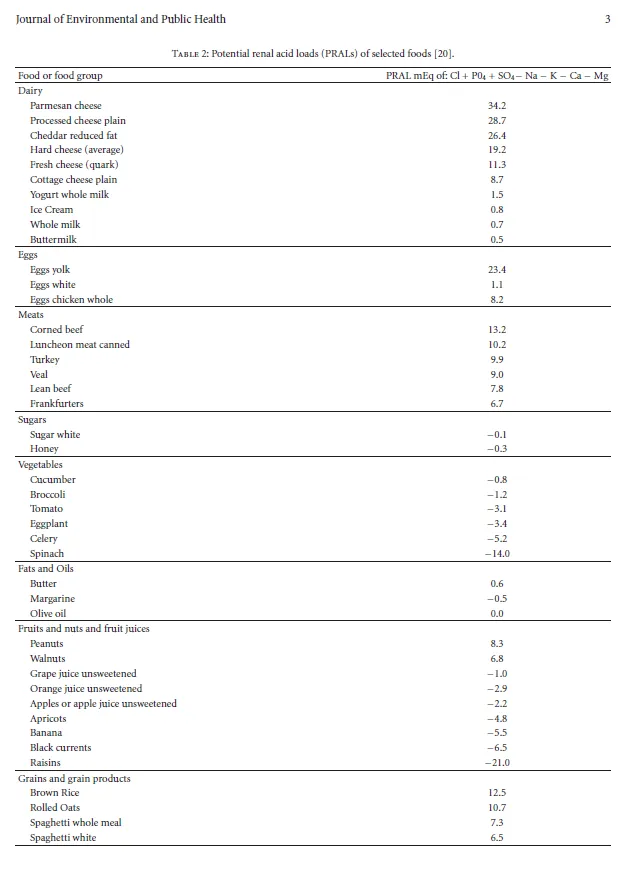
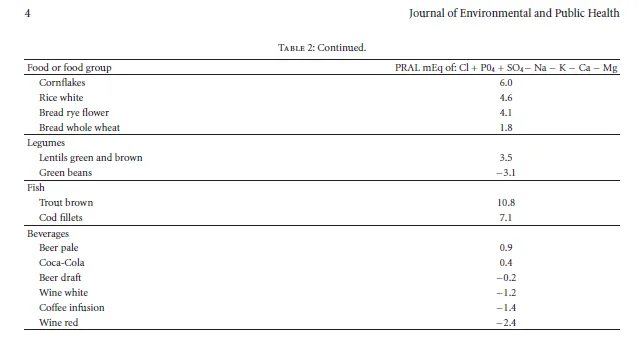
To properly try the alkaline diet, Rosa used the following table, which lists foods with their effect on the acid-base metabolism of the system. Foods with positive numbers in the right hand column increase metabolic acid, while those with negative numbers reduce it. For example, egg yolks have a highly acidic effect, raisins a highly alkaline effect.
Rosa asked how an acidic food like oranges could have an alkaline effect. After all, oranges are rich in citric acid. All I could tell her is that the human liver takes citric acid and metabolizes it into bicarbonate, an alkalinizing agent. It does the same with the malic acid in apple and acetic acid in vinegar. Citric, malic, and acetic acid, by the way, have been a basic requirement of life for billions of years, and we can synthesize them on our own. Cows have plenty of citrate in them and eat no oranges. These substances interact with the most foundational functions of our biochemistry in many ways. Bodily pH is governed by the lungs and kidneys, mostly, but other organs such as the bones and liver play a role as well - which is why isolating one factor, such as diet or citric acid metabolism, is so difficult.
Supplements and pH
Section titled “Supplements and pH”Some of you require acid-producing supplements to improve digestion, as described in a previous newsletter. If this helps you, do not stop as a result of reading this newsletter. Check with me first.
The best supplement for systemic alkalization at this time seems to be potassium bicarbonate. Especially if you take certain chemotherapeutic agents, this substance seems to aid effectiveness. Since potassium excess can be dangerous, especially with waning kidney function, ask your doctor first.
Guidelines
Section titled “Guidelines”Just because a food is listed as alkaline-producing rather than acid-producing, does not mean it is a healthy food. Margarine, at -0.5 is still a transfat. I'd prefer to eat lentils at 3.5 to white sugar at -0.1. And face it, parmesan cheese, the most acid-forming food on the list above, is not going to drop you to the ground if you grate a bit onto your pasta. May I suggest moderation?
- Yes, increase your intake of fresh fruits and vegetables -- food that's in season, within reason.
- When something new appears (those late summer figs!), eat them! Variety leads to satiety!
- Shop the perimeter of the store, where they stock the fruit and veggies. If you buy them and bring them home, your thrift will drive you to eat them before they go bad. This way, economy will promote longevity!
- Food that's tasty and served with love, even the lowly hot dog, is a blessing. Enjoy your food.
Easy Does It
Section titled “Easy Does It”I congratulated Rosa for her analytic attitude towards the books and websites that tout an alkaline diet as a means to treat cancer and other serious illnesses. She could tell that most of what she read on these sites was scientific nonsense.
She was relieved when I suggested she spend her money on high quality fresh food rather than the expensive machine her neighbor recommended.
Finally, she readily agreed that most important to her was to keep her weight up and eat food she enjoyed and could buy and prepare within the time she had. And she certainly would include more fresh fruit and vegetables.
Follow us on Facebook. You might enjoy our recent posting about sugar at https://www.facebook.com/rienstraclinic.
Correction
Section titled “Correction”Our January 2011 newsletter about walking recommended that you walk with feet pointed straight ahead to maximize distance covered with each step. I've since learned that this will most often place excessive stress on the hip joints, and have removed this part of the newsletter. For most of us, walking with the feet angulated slightly to the side provides the best leverage for the muscles around the pelvis.
We Appreciate Your Support
Section titled “We Appreciate Your Support”Most people hear about us through word of mouth. Please tell your friends and family about us.
Endnotes
Section titled “Endnotes”[1] N. Raghunand and R. J. Gillies, "pH and chemotherapy," Novartis Foundation Symposium, vol. 240, pp. 199-211, 2001.
[2] N. Raghunand and R. J. Gillies, "pH and chemotherapy," Novartis Foundation Symposium, vol. 240, pp. 199-211, 2001.
[3] An example of such a study: Nutrition & Metabolism 2012, 9:72
[4] BioMed Research International Volume 2013, Article ID 485196,
[5] Eur J Nutr 40 : 200-213 (2001)
[6] Alkaline diets favor lean tissue mass in older adults. Bess Dawson-Hughes, Susan S Harris, and Lisa Ceglia Am J Clin Nutr 2008;87:662-5.
[7] Fruit and vegetable consumption and all-cause mortality: a dose response analysis. Andrea Bellavia, Susanna C Larsson, Matteo Bottai, Alicja Wolk, and Nicola Orsini. Am J Clin Nutr 2013;98:454-9
[8] Kidney Int. 2012 May ; 81(10): 1033-1042.
[9] CMAJ • FEBRUARY 9, 2010 • 182(2) 137
Serum anion gap, bicarbonate and biomarkers of inflammation in healthy individuals in a national survey Wildon R. Farwell MD MPH, Eric N. Taylor MD MSc From the Massachusetts Veterans Epidemiology Research and Information Center, VA Boston Healthcare System, and the Division of Aging, Department of Medicine, Brigham and Women's Hospital, Harvard Medical School (Farwell); and the Renal Division and Channing Laboratory, Department of Medicine, Brigham and Women's Hospital, Harvard Medical School (Taylor), Boston, USA CMAJ 2009. DOI:10.1503/cmaj.090329 Background: In vitro data suggest that lower extracellular pH activates the immune system. We conducted a population-based study of the relation between serum acid.base status and inflammation. Methods: We examined the serum anion gap and serum levels of bicarbonate and inflammatory biomarkers in 4525 healthy adults who participated in the National Health and Nutrition Examination Survey during 1999. 2006. We excluded participants who had chronic disease, recent infection and an estimated glomerular filtration rate of less than 60 mL/min per 1.73 m2. Results: The mean values of serum anion gap, bicarbonate level, leukocyte count and C-reactive protein level were all within normal limits. After adjustment for age, sex, ethnic background, body mass index, serum albumin level and other factors, we found that a higher anion gap and lower bicarbonate level were associated with a higher leukocyte count and higher C-reactive protein level. Compared with participants in the lowest quartile of anion gap, those in the highest quartile had a leukocyte count that was 1.0 ?~ 109/L higher and a C-reactive protein level that was 10.9 nmol/L higher (p < 0.01). Compared with participants in the highest quartile of bicarbonate level, those in the lowest quartile had a leukocyte count that was 0.7 ?~ 109/L higher and a C- reactive protein level that was 4.0 nmol/L higher (p . 0.02). A higher anion gap and lower bicarbonate level were also associated with a higher platelet count, a larger mean platelet volume and a higher ferritin level. Interpretation: A higher serum anion gap and lower bicarbonate level were associated with higher levels of inflammatory biomarkers in a healthy sample of the general population. Further studies are needed to elucidate the relation between acid-base status and inflammation.
[10] Am J Clin Nutr 2013;98:6-15
[11] The Alkaline Diet: Is There Evidence That an Alkaline pH Diet Benefits Health? Gerry K. Schwalfenberg Journal of Environmental and Public Health Volume 2012, Article ID 727630, 7 pages
[12] Nutrition Journal 2009, 8:41
[13] Milk and Acid-Base Balance: Proposed Hypothesis versus Scientific Evidence. Tanis R. Fenton, PhD, Andrew W. Lyon, PhD
Journal of the American College of Nutrition, Vol. 30, No. 5, 471S-475S (2011)
"Recently the lay press has claimed a hypothetical association among dairy product consumption, generation of dietary acid, and harm to human health. This theoretical association is based on the idea that the protein and phosphate in milk and dairy products make them acid-producing foods, which cause our bodies to become acidified, promoting diseases of modern civilization. Some authors have suggested that dairy products are not helpful and perhaps detrimental to bone health because higher osteoporotic fracture incidence is observed in countries with higher dairy product consumption. However, scientific evidence does not support any of these claims. Milk and dairy products neither produce acid upon metabolism nor cause metabolic acidosis, and systemic pH is not influenced by diet. Observations of higher dairy product intake in countries with prevalent osteoporosis do not hold when urban environments are compared, likely due to physical labor in rural locations. Milk and other dairy products continue to be a good source of dietary protein and other nutrients."
Key teaching points:
Measurement of an acidic pH urine does not reflect metabolic acidosis or an adverse health condition.
The modern diet, and dairy product consumption, does not make the body acidic.
Alkaline diets alter urine pH but do not change systemic pH.
Net acid excretion is not an important influence of calcium metabolism.
Milk is not acid producing.
_ Dietary phosphate does not have a negative impact on calcium metabolism, which is contrary to the acid-ash hypothesis."
[14] Gerry K. Schwalfenberg, in the Journal of Environmental and Public Health at http://www.ncbi.nlm.nih.gov/pmc/articlesPMC3195546/ . Schwalfenberg's article, by the way, summarizes very concisely what is known and unknown about the acid/alkaline hypothesis.