

- The brain is different from all other tissues of the body in the complexity of its structure and its intricate web of tiny nerve tendrils.
- These create a massive appetite for energy production.
- When that energy production is impaired, brain tissue is destroyed. Certain nutrients can provide a protective cushion.
- Impairment of blood flow can interfere with brain function.
- One mechanism of blood vessel damage is microinflammation.
Cells that Support the Neurons - the Glia
Section titled “Cells that Support the Neurons - the Glia”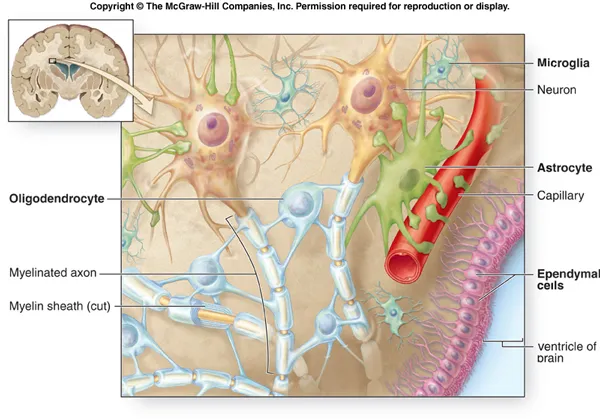
This image from McKinley/O'Loughlin Human Anatomy appears by permission of the publisher, McGraw-Hill.
This wonderful illustration shows two neurons. Their cell bodies, each with its nucleus, appear in the upper half of the image looking like a pair of eyes. The axons of the neurons extend downward, and the dendrites, which bring the incoming signal, come in from above. For more on neurons click here. We will ignore the fluid filled ventricle at lower right and the purplish cells that line it. Let's just note that the red blood vessel on the right is surrounded, as are all capillaries in the brain, by processes extending from an astrocyte here pictured in green. For each neuron, there are about ten astrocytes. These surround the capillaries as part of the blood brain barrier. Astrocytes also furnish nourishment and raw materials to neurons and help maintain the chemical environment within the brain.
The blue cells, the oligodendrocytes, provide insulation for the axons of the neurons, the myelin sheath, which speeds nerve conduction. Damage to the myelin sheath occurs with multiple sclerosis.
Toxins
Section titled “Toxins”The liver removes toxins in a two-step process. In the first step, special enzymes in the liver chemically alter specific toxins. The potency of these enzymes varies from person to person, which is why one person can burn up the caffeine in a cup of coffee in an hour or two, while her neighbor can't get to sleep if she has any caffeine at lunch.
In step two, the liver takes the altered toxin and combines it with sulfate, glutathione, or another substance, then sends it on into the bile duct or to the kidney. Your physician can test these systems (PDF).
Smoking
Section titled “Smoking”The Chinese observed 2800 people for two years and found that heavy smokers developed Alzheimer's dementia at three times the rate of people who had never smoked. They developed vascular dementia at twice the rate. These findings fit with the idea that cigarette smoke has a direct toxic effect on the brain, in addition to damaging blood vessels (the cause of vascular dementia). The study was published in the European Journal of Neurology in 2004 (11(4):277-82).
Estrogen
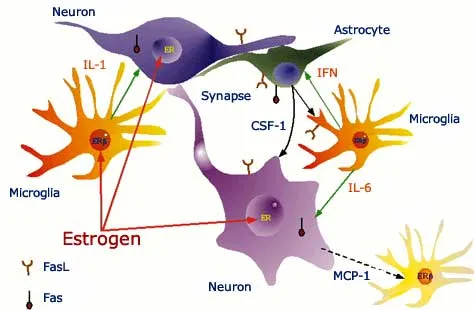
Section titled “Estrogen”Women who take supplemental estrogen develop Alzheimer's dementia less than half as frequently as women who do not. Studies indicate that estrogen sends a calming message to the microglia and neurons, making them less prone to production of inflammatory cytokines such as interleukin-1 (IL-1), interleukin-6 (IL-6), Colony Stimulating Factor-1 (CSF-1), Monocyte chemotactic protein-1 (MCP-1), and interferon (IFN), shown in the image below.
Of course, estrogen, even natural estrogen, does slightly increase the risk of breast and uterine cancer. Healthy diet can decrease that risk. There are many things to think about before taking estrogen. Every woman has different needs.